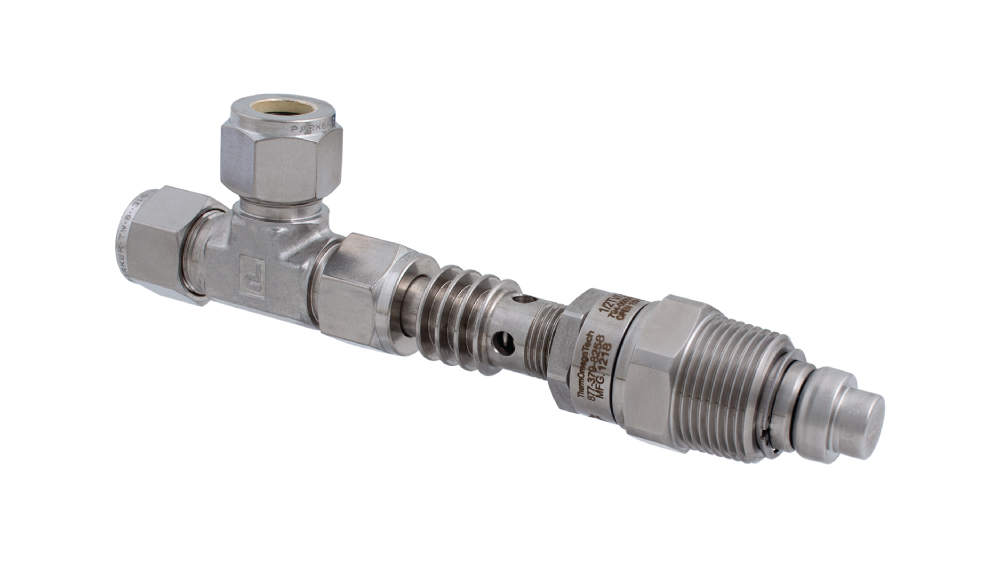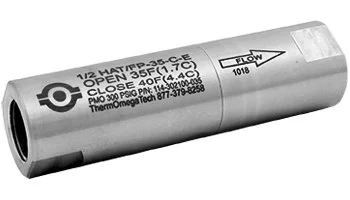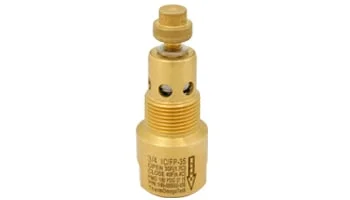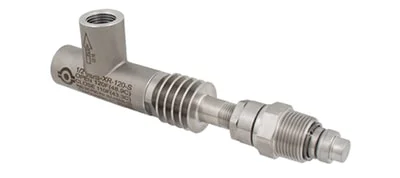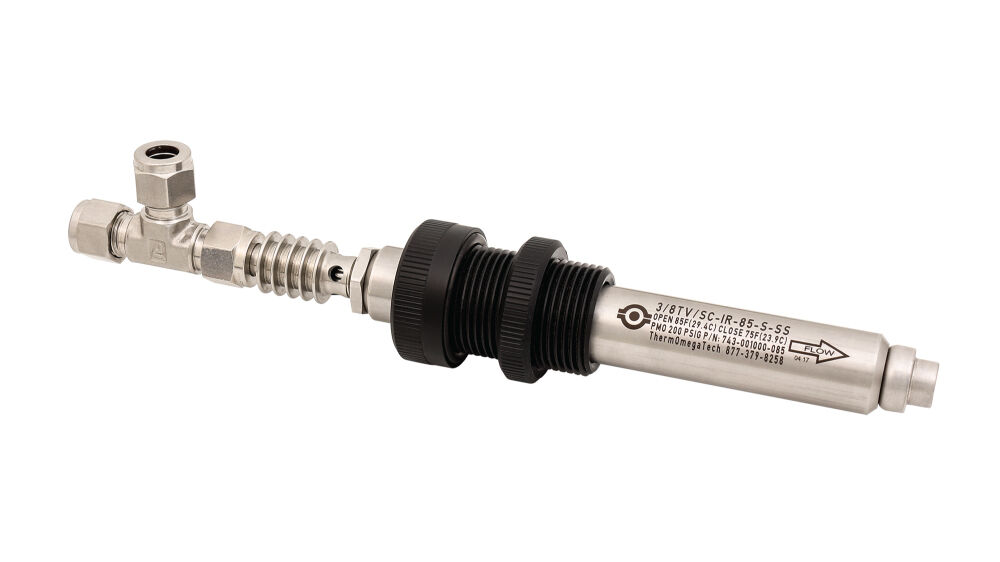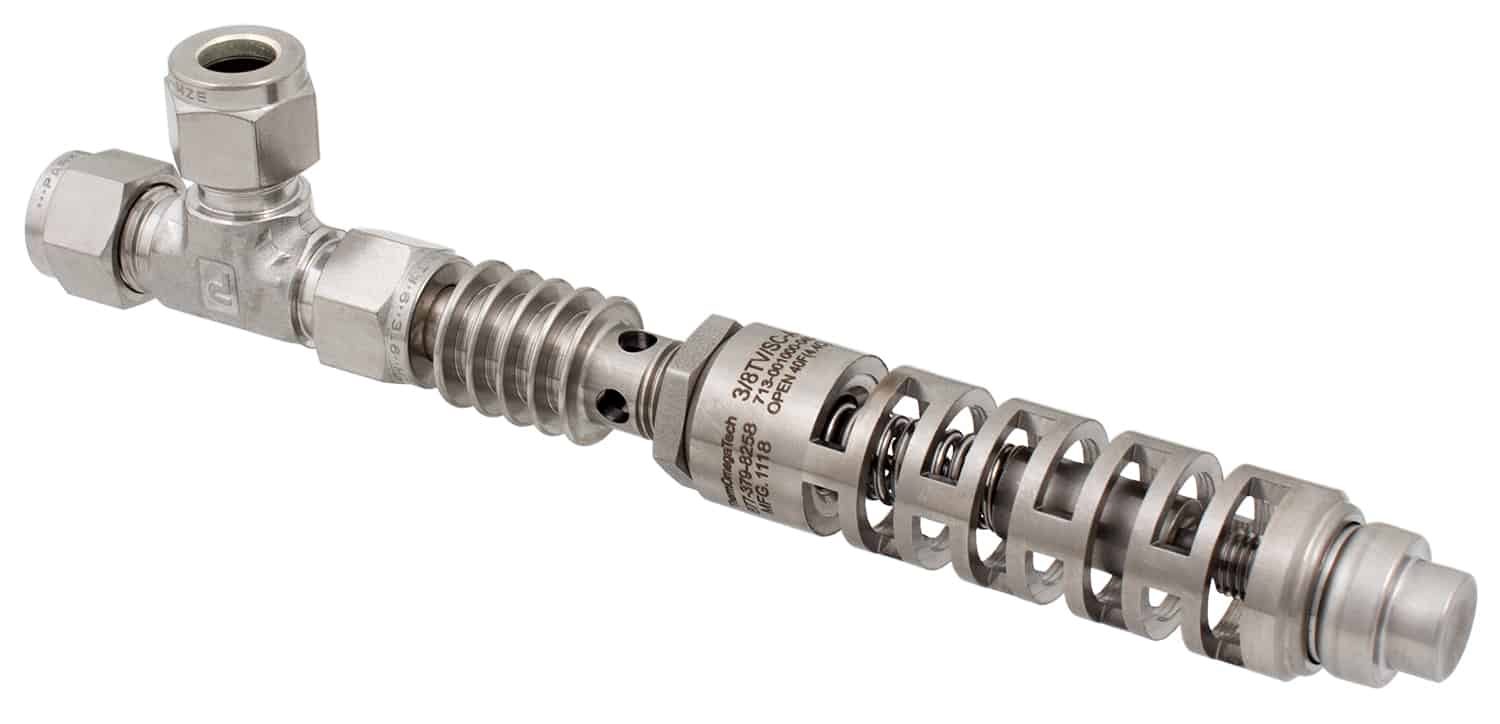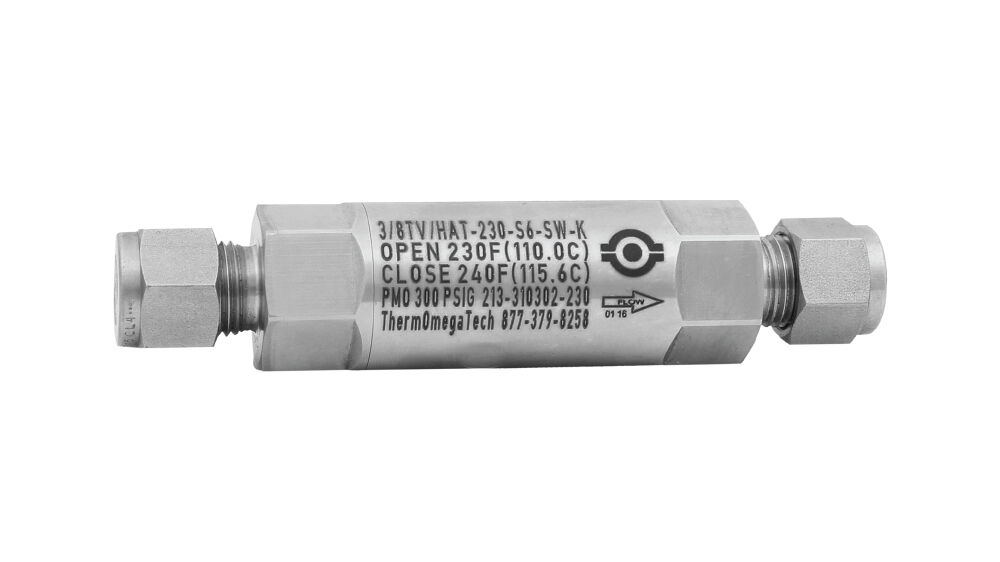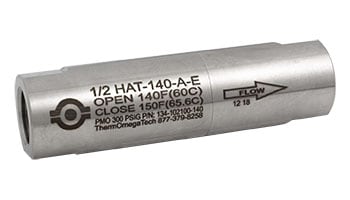

Inline Temperature Control Valve Overview
The HAT is a compact fluid temperature control valve for applications requiring controlled return or discharge temperatures. Multiple temperature settings, seal materials, and construction options allow the HAT to be configured for different fluids and operating conditions.
For cooling applications that require the valve to open as fluid temperature rises, use the HAT/RA cooling fluid control valve.
Design Features
- Exclusive Thermoloid® wax thermal actuator
- Compact, low-mass design for responsive temperature control
- Corrosion-resistant – stainless steel body, fittings, spring, and plug
- Ram-type plug for reliable shutoff
- Two wrench flats for easy installation
- Operates in any orientation
- Unaffected by pressure variations
- Optional leak port (LP) available
Typical Applications
- Subcooling steam trap: Functions as a thermostatic steam trap that discharges cooled condensate to an unpressurized outlet for temperature-based steam condensate control.
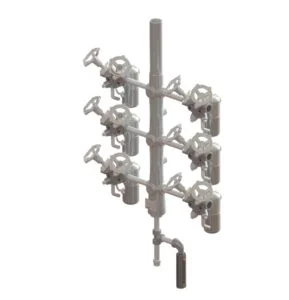
- Glycol tracing temperature control: Maintains the required return fluid temperature in glycol heat tracing systems used for winterization and process temperature maintenance.
- Condensate freeze protection: Opens as fluid temperature falls to discharge condensate before it can freeze in exposed piping.
- High-temperature protection for commercial aircraft galleys: Closes to prevent high-temperature water from entering cold-water lines where galley manifolds connect coffee makers and faucets, reducing the risk of scalding.
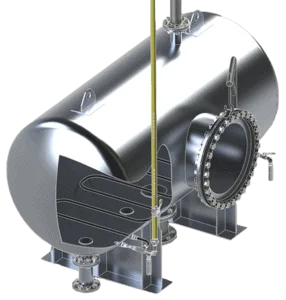
- Tank heating coil temperature control: Modulates closed as temperature rises to limit heating and reduce the risk of over-temperature conditions.
- Sampling system high-temperature shutoff: Remains open below the specified temperature and closes as sample temperature rises to protect downstream analyzers and instrumentation.
Technical Documents
Specifications
- Sizes: ½”, ¾”
- Maximum Operating Pressure: 300 PSIG (20.7 bar)
- Maximum Temperature: Range 150ºF (83.3ºC) over set point with a limit of 300ºF (149ºC)
Ordering
| Part Number | Description |
|---|---|
| 134 – 202X00 – XXX | 1/2” HAT B-Port Brass Internals |
| 134 – 212X00 – XXX | 1/2” HAT B-Port, all 300 Series SS |
| 134 – 802X00 – XXX | 1/2” HAT B-RF1 Brass Internals |
| 134 – 812X00 – XXX | 1/2” HAT B-RF1, all 300 Series SS |
| 134 – 224X00 – XXX | 1/2” HAT B-Port, all 316 SS |
| 134 – 824X00 – XXX | 1/2” HAT B-RF1, all 316 SS |
| 134 – 224X20 – XXX | 1/2” HAT B-Port, 316 SS Passivated |
| 134 – 302X00 – XXX | 1/2” HAT C-Port |
| 134 – 312X00 – XXX | 1/2” HAT C-Port, all SS |
| 134 – 502X00 – XXX | 1/2” HAT C-RF |
| 134 – 324X20 – XXX | 1/2” HAT C-Port, 316 SS Passivated |
| 135 – 502X00 – XXX | 3/4” HAT D-Port |
| 135 – 512X00 – XXX | 3/4” HAT D-Port, all SS |
Ordering & Configuration Notes
- RF= Reverse Flow. Flow direction is reversed in valves that close over 210°F (98.9°C). Reverse flow valves are rated for 150 PSIG (10.3 bar).
- Seal Material compatibility:
- EPDM – air, glycol, water, steam, ketones, and synthetic hydraulic oils
- Viton – air, fuel, oil, gas, petroleum-based hydraulic oils
- Kalrez
- Silicone
- Full open temperatures “XXX” available: 040°F, 050°F, 055°F, 060°F, 065°F, 075°F, 085°F, 090°F, 095°F, 100°F, 105°F, 110°F, 120°F, 125°F, 130°F, 140°F, 150°F, 155°F, 160°F, 170°F, 180°F, 190°F and 200°F.
- Closing temperature is typically 10°F above the opening temperature.
- Replace singular “X” with 1 for EPDM body seals; 2 for Viton body seals. For other seal options or leak port designs consult our product team.
Certifications
NSF/ANSI/CAN 61 & 372 Certified options available.
How the HAT Valve Works
This temperature-activated valve uses a thermal wax actuator to continuously sense the temperature of the fluid passing through the valve.
As fluid temperature falls below the valve’s set point, the valve modulates open to initiate flow. As temperature rises, the valve will modulate closed to control flow. The specified temperature is the valve’s full-open temperature, with closing typically occurring approximately 10°F above that temperature.
An optional built-in leak port provides continuous bypass flow when required by the application.