
HOW IT WORKS
Paraffin Wax Thermal Actuator Technology
Self-actuating thermal control that converts temperature changes into mechanical motion without external power, sensors, or electronic controls.
Self-Actuating Temperature Control
ThermOmegaTech® designs and manufactures thermal actuators that use the phase change of paraffin wax to produce controlled, repeatable mechanical motion in response to temperature.
This temperature-driven motion can regulate fluid flow, control temperature, or actuate mechanical components. The technology can be integrated into stand-alone actuators, valve cartridges, and complete thermostatic valve across a range of systems.
Explore Thermal ActuatorsHow Does a Wax Motor Work?
A wax motor, also called a thermal actuator, thermostatic actuator, or wax thermostatic element, converts thermal energy into linear mechanical motion.
The actuator contains a sealed capsule filled with paraffin wax. As temperature increases through the wax’s phase-change range, the material transitions from solid to liquid and expands in volume. This expansion acts against a diaphragm and plug or piston assembly, extending the actuator piston.
As temperature decreases, the wax transitions back toward its solid state and contracts. A return force, typically supplied by a spring or the mechanism being actuated, retracts the piston.
Because piston position changes in response to temperature, the actuator can directly operate a valve, lever, damper, switch, or other mechanical device.
Thermoloid® Paraffin Wax Technology
At the core of ThermOmegaTech® thermal actuators is Thermoloid®, our proprietary blend of paraffin wax. Its composition determines the temperature range over which phase change occurs, allowing actuator performance to be matched to application requirements.
Thermoloid® produces mechanical stroke over a narrow activation range, typically 10°F to 20°F. Because the wax is essentially incompressible, its expansion can generate substantial force from a compact actuator package while changes in load have little to no effect on the wax’s actuating temperature.
Typical Thermal Actuator Performance
| Parameter | Typical Performance |
| Actuation Temperature Range | 15°F to 300°F |
| Typical Stroke | 0.05 to 0.5 in. |
| Typical Extending Force | 5 to 150 lbf |
| HOP Actuators | Over 1,000 lbf possible |
Predictable Temperature-to-Stroke Response
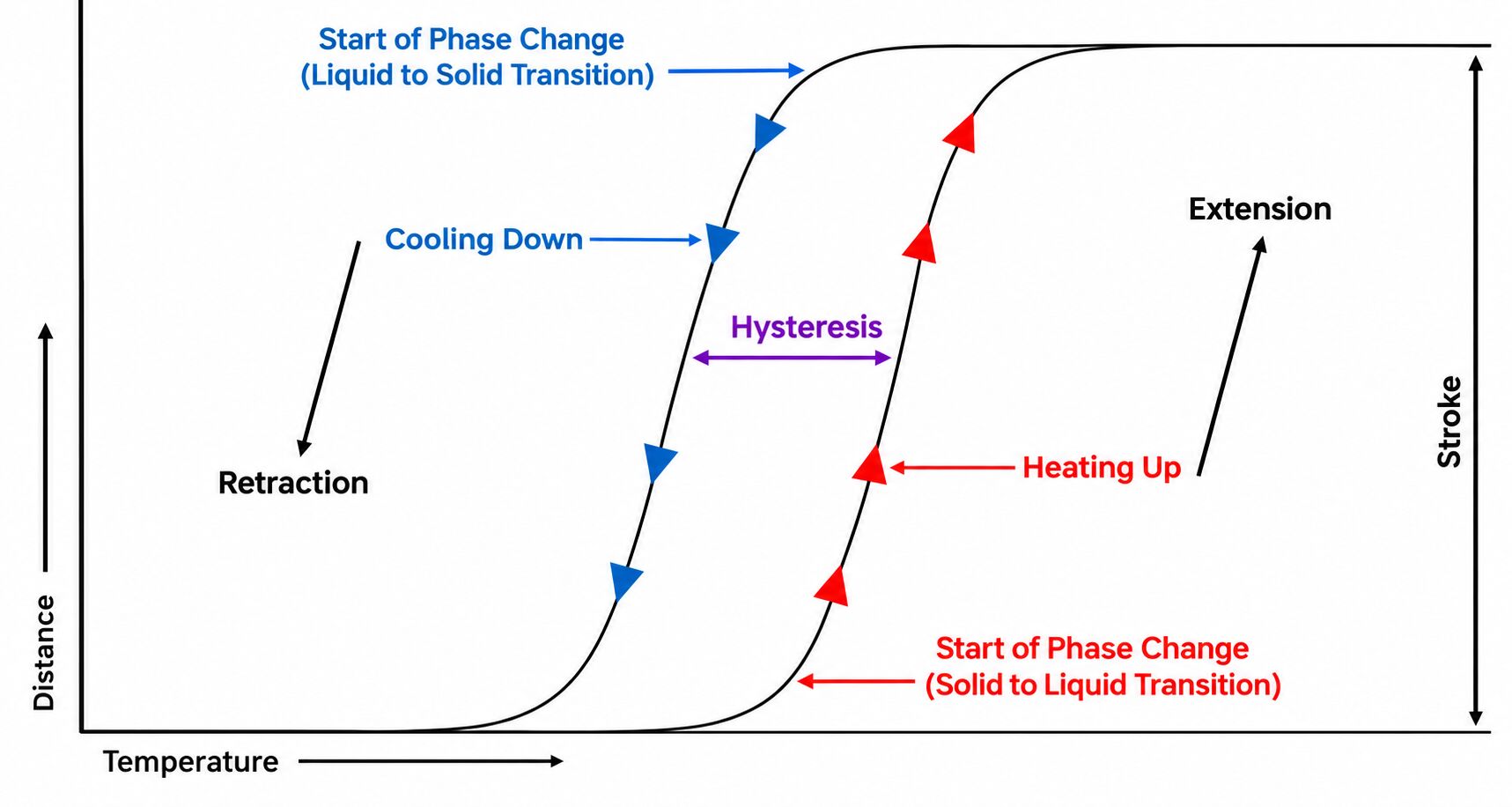
Thermal actuator performance is defined by the relationship between temperature and piston travel. A stroke curve plots this relationship, showing how far the piston extends or retracts as temperature changes through the wax’s phase-change range.
As the wax heats, the piston progressively extends rather than simply switching between two positions. As it cools, the piston retracts along a slightly different temperature path. The temperature difference between the heating and cooling stroke curves is known as hysteresis, a natural characteristic of paraffin wax.
Wax composition, actuator design, applied load, operating conditions, and service life can affect stroke and response. Understanding these characteristics allows ThermOmegaTech® engineers to select or configure the actuator around the required temperature range, stroke, force, and system behavior.
Download Thermal Actuator White Paper for additional information on stroke curves, hysteresis, response time, wax behavior, and actuator design.
KEY BENEFITS
Advantages of Wax Thermal Actuators
Self-Actuating
Responds directly to temperature without sensors, controllers, software, or electrical actuation.
Predictable Response
Produces repeatable piston movement as system temperature increases and decreases.
High Force-to-Size Ratio
Generates substantial mechanical force from a compact actuator package.
Low SWaP
Compact, lightweight, power-free operation supports applications with strict size, weight, and power requirements.
Designed for Demanding Environments
Mechanical, power-free operation supports use in pressure or vacuum conditions, liquid or gas applications, hazardous and explosion-proof environments, and systems subject to shock and vibration.
Pressure Independent
Temperature-driven actuation is unaffected by changes in system pressure.
Wax Thermal Actuators vs. Electrically Powered Actuation
When mechanical action can be tied directly to temperature, a wax thermal actuator can eliminate components required by electrically controlled actuation systems.
| Wax Thermal Actuator | Electrically Controlled Actuation | |
| Power source | Temperature change | Electrical power |
| Temperature Sensor | Not required | Typically required |
| Controller | Not required | Typically required |
| Response | Directly tied to temperature | Commanded by control system |
| Power-loss Operation | Continues to respond to temperature | Depends on system design |
Reducing sensors, wiring, controllers, and power requirements can simplify system integration and eliminate electrical failure points.
Thermal Actuator Technology Across Critical Industries
ThermOmegaTech® paraffin wax thermal actuator technology provides temperature-driven control across commercial plumbing, industrial, railroad, and aerospace and defense systems.
Commercial Plumbing
Controls domestic hot water recirculation, domestic cold water recirculation, drain discharge temperature, and tepid water delivery systems.
Industrial
Regulates temperature and fluid flow for heating, cooling, personnel safety, equipment protection, and process applications.
Railroad
Provides freeze protection for locomotive cooling systems and passenger rail potable water systems.
Aerospace & Defense
Provides thermal control for avionics cooling, fuel and oil thermal management, freeze and scald protection, thermal bypass, and mechanical actuation.
Find the Right Temperature Control Solution
Thermal actuator performance depends on the complete system, including temperature range, required stroke, applied load, return force, response time, cycle requirements, packaging, materials, and environmental conditions.
ThermOmegaTech® engineers work with OEMs and system designers to evaluate operating requirements and determine the appropriate configuration, whether a stand-alone thermal actuator, cartridge, thermostatic valve, or application-specific assembly.
Talk with our team to determine the appropriate temperature control solution for your application.