
Thermal Actuators Overview
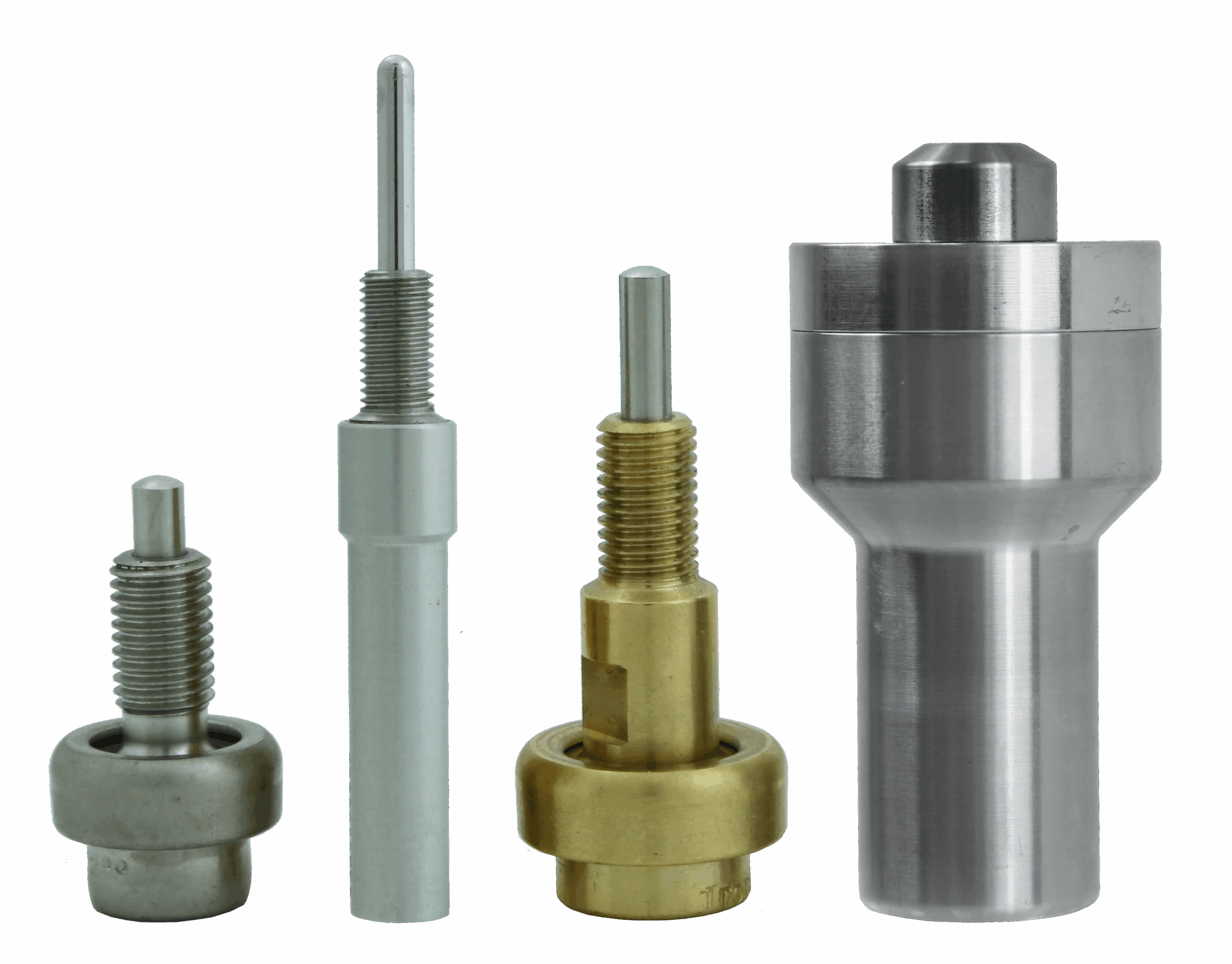
ThermOmegaTech® wax actuators use proprietary Thermoloid® paraffin wax material to produce controlled piston movement over a defined temperature range. Standard actuators are available in multiple sizes, force outputs, materials, and configurations.
They can be supplied separately for integration into an OEM system or incorporated into a custom thermostatic valve or cartridge.
For applications requiring greater force and stroke, High Output Paraffin Actuators (HOPA) provide increased mechanical output.
For more information about phase-change operation, stroke behavior, hysteresis, and actuator performance, visit our Paraffin Wax Thermal Actuator Technology page.
Additional Key Features
- Maintenance-Free: No periodic calibration or service requirements.
- Simple Mechanical Design: Fewer components reduce potential failure points.
- Resistant to Shock & Vibration: Supports operation in demanding environments.
Engineered for System Integration
ThermOmegaTech® thermal actuators can be integrated into temperature-actuated valves, switches, latches, clamps, and other control devices to regulate fluid or gas flow or control mechanical movement as conditions change.
We work with Aerospace, Defense, and Industrial OEMs to supply standard actuators or develop a custom actuator, cartridge, or valve configurations.
Complete a Custom Actuator or Valve Request
For examples of fluid control, airflow management, positioning, and release applications, visit our Thermal Actuation Applications page.
High Output Paraffin Actuators (HOPA)
HOPA actuators extend paraffin wax actuation to applications requiring greater force and stroke than standard thermal actuators. Their compact, self-contained design supports demanding operating environments and applications requiring temperature-driven or externally activated mechanical movement.
Key Features
- High Output Force: Delivers over 1000 lbf
- Extreme Environment Capability: Designed for demanding pressure, vacuum, and environmental conditions
- Nonexplosive Operation: Provides mechanical actuation without an explosive release device
- External Heat Source Activation: Can be activated on command using an external heat source
Technical Documents
Standard Thermal Actuator Specifications
ThermOmegaTech® thermal actuators are available in diaphragm and sliding-seal designs with multiple sizes and force outputs to support different system requirements.
- Start-to-stroke temperature range: 15°F to 300°F (-9.4°C to 149°C)
- Typical temperature change to maximum stroke: 10°F to 20°F (5.5°C to 11.1°C)
- Materials: 303 Stainless Steel, 316 Stainless Steel, and Brass
- Alternative materials: Duplex 2205 and 2507 Stainless Steel – others available upon request
- Chemical treatments: Passivation, Electropolishing, NACE Annealing, Chemfilm, and anodizing
- Operating environment: Suitable for pressure or vacuum conditions and liquid or gas environments
Minimum/Maximum Applied Force
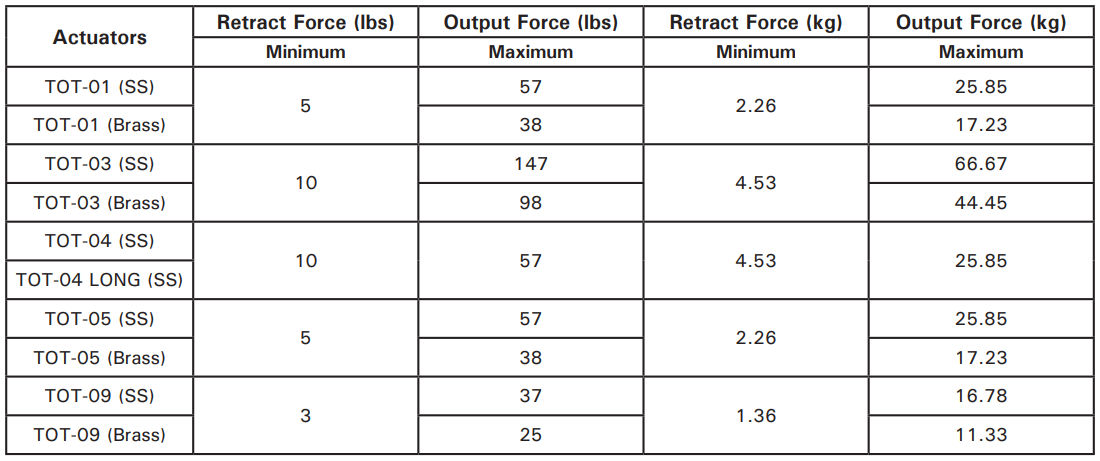
Available actuator designs provide different minimum retract-force and maximum output-force capabilities. Standard models range from 25 to 147 lbf maximum output force, depending on actuator model and material. Required return force must also be considered during actuator selection.
High Output Paraffin Actuator Specifications
HOPA actuators are designed for applications requiring greater stroke and mechanical output than standard thermal actuators.
- Start-to-stroke temperature range: 15°F to 300°F (-9.4°C to 148.8°C)
- Typical temperature change to maximum stroke: 10°F to 20°F (5.5°C to 11.1°C)
- Output force: Delivers over 1,000 lbf
- Materials: 303 and 316 stainless steel, brass, Duplex 2205 and 2507 stainless steel, and Aluminum 7075; others available upon request
- Operating environment: Suitable for pressure or vacuum conditions and liquid or gas environments; resistant to shock and vibration.
- Outgassing: Negligible
- Activation: External heat-source activation available
Passivation, electropolishing, NACE annealing, Chemfilm, and anodizing are available based on material and application requirements.
Thermal Actuator Integration
Thermal actuator integration must account for the mechanical load, available piston travel, return force, mounting, and conditions being sensed.
Integration Considerations
When incorporating a thermal actuator into a system, consider:
- Activation range: Select the actuator response range based on the required operating set point.
- Force and stroke: Confirm that the selected actuator provides the movement and output force required by the load.
- Return force: Provide the required spring or mechanical counterforce to retract the piston as conditions move below the actuator’s operating range.
- Available space: Allow adequate clearance for actuator dimensions and full piston travel.
- Mounting: Select or develop a mounting configuration that maintains proper alignment between the actuator and driven component.
- Sensing conditions: Position the actuator so it responds to the fluid, gas, surface, or surrounding conditions that are intended to control the mechanical function.
- Environment: Confirm materials and configuration for pressure, vacuum, media, temperature, and other environmental requirements.
For custom OEM installations, ThermOmegaTech® can review the system requirements and determine the appropriate standard actuator, custom actuator, HOPA, thermostatic cartridge, or complete valve configuration.