
Thermostatic Mixing Valve and Diverting Valve Overview
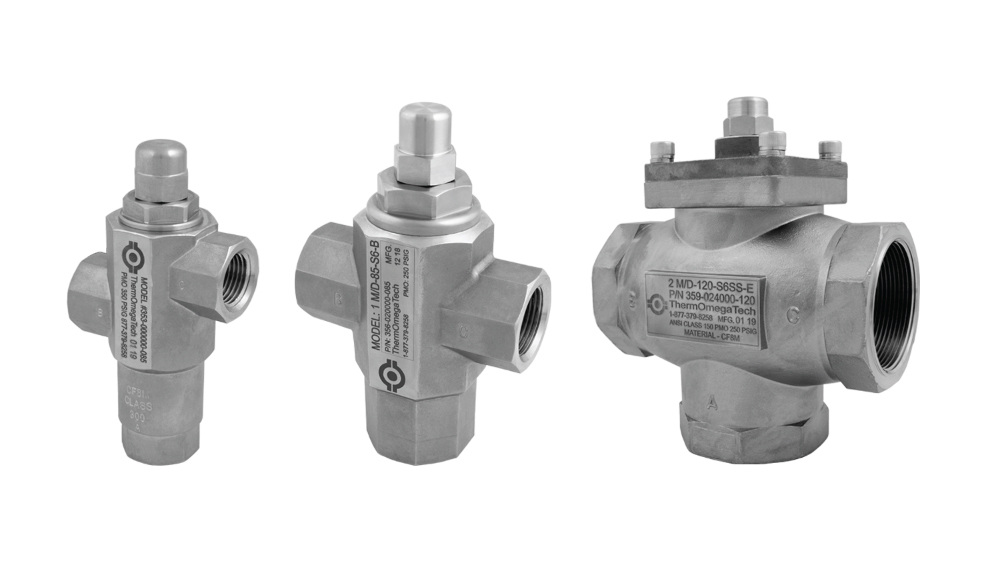
The M/D uses a common 3-way valve platform for mixing or diverting fluid temperature control. The valve regulates flow to maintain the required operating temperature and protect temperature-sensitive equipment and processes.
Multiple sizes, body materials, seal options, and temperature settings allow the valve to be configured for specific media and operating requirements. Cartridge configurations are also available for system integration. Custom temperatures, materials, and port positions are available upon request.
Mixing and Diverting Thermal Valves
Mouse over an image of a thermostatic mixing valve/diverting valve to animate.
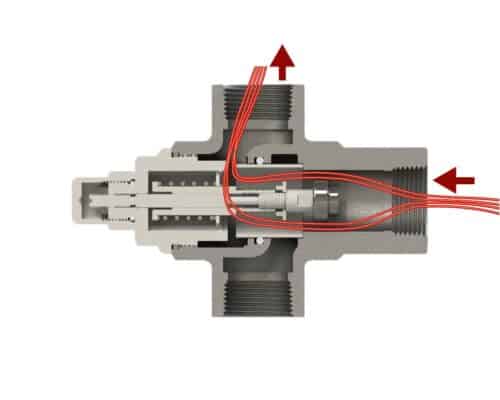
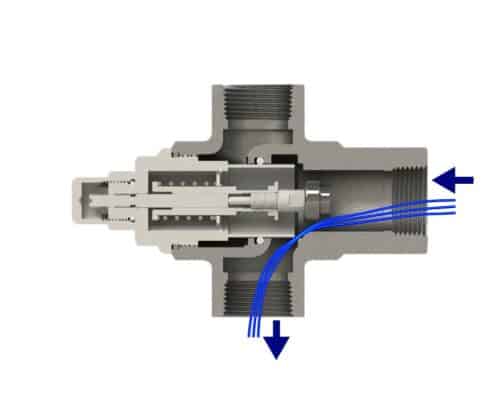
Installed in diverting mode, the valve’s thermal actuator will sense the fluid temperature and automatically divert the inlet flow to either of the two outlet ports depending on the valve’s specified temperature requirements.
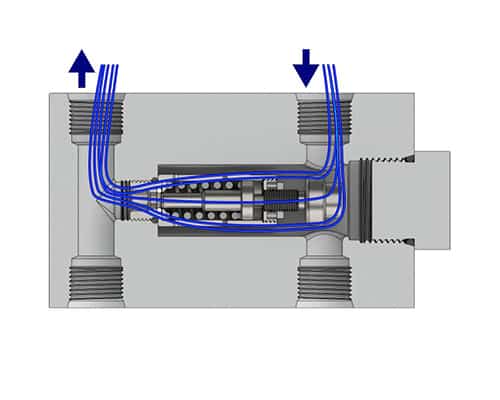
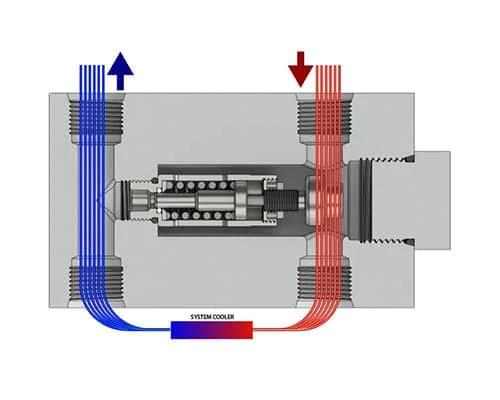
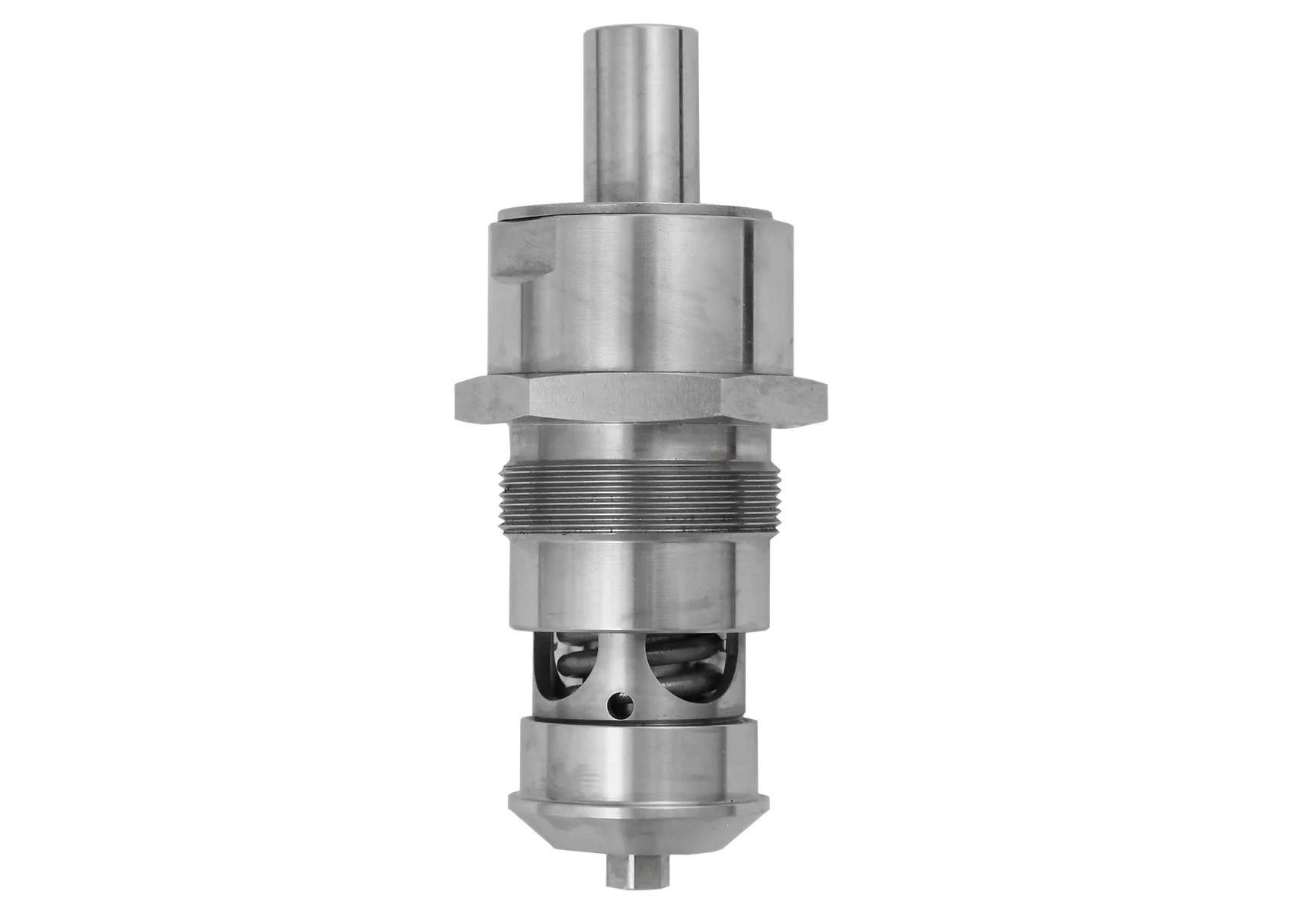
The TBV cartridge can be integrated into a 4-way manifold to monitor inlet flow and divert the fluid based on temperature. Cooler fluid goes through the valve bypass circuit, while hotter fluid goes through the system’s cooler.
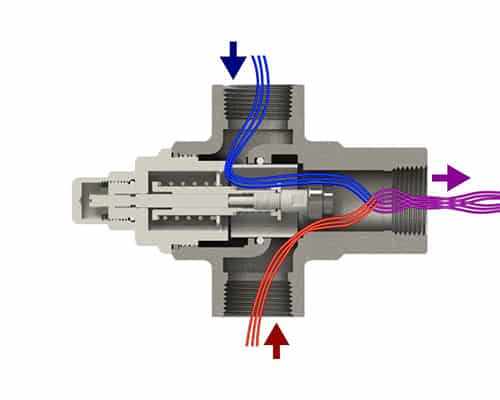
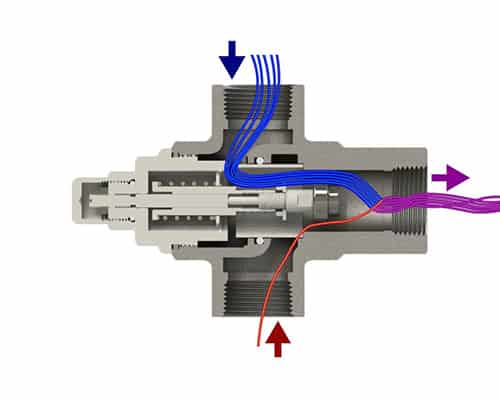
Installed in mixing mode, the mixing valve’s thermal actuator will sense the temperature to automatically proportion the flow of hot and cold fluid from two inlet ports to produce the desired outlet temperature.
Design Features
- Exclusive Thermoloid® wax thermal actuator responds directly to fluid temperature
- Heavy-duty – rugged construction
- Compact and low mass for fast response
- Supports integration into new or existing systems
- Operates in narrow temperature band
Selecting an M/D Valve
M/D valve selection is based on:
- Mixing or diverting function
- Fluid/media
- Required temperature set point
- Flow rate and Cv
- Operating pressure
- Valve and seal material
- Connection size and configuration
Typical Applications
Cooling and Thermal Management
- Battery cooling
- Electronics cooling
- Engine and compressor cooling
- Radiator and heat exchanger control
Hydraulic and Lubrication Systems
- Hydraulic power units
- Hydraulic fluid cooling
- Hydraulic thermal bypass
- Lube oil cooling
- Lube oil thermal bypass
Process Fluid Temperature Control
- Direct cooling with water
- Direct injection water heating
- Loop-type circulation systems
- Fluid mixing and diverting
- Water temperature control
Technical Documents
Product Literature
Specification & Installation
Specifications
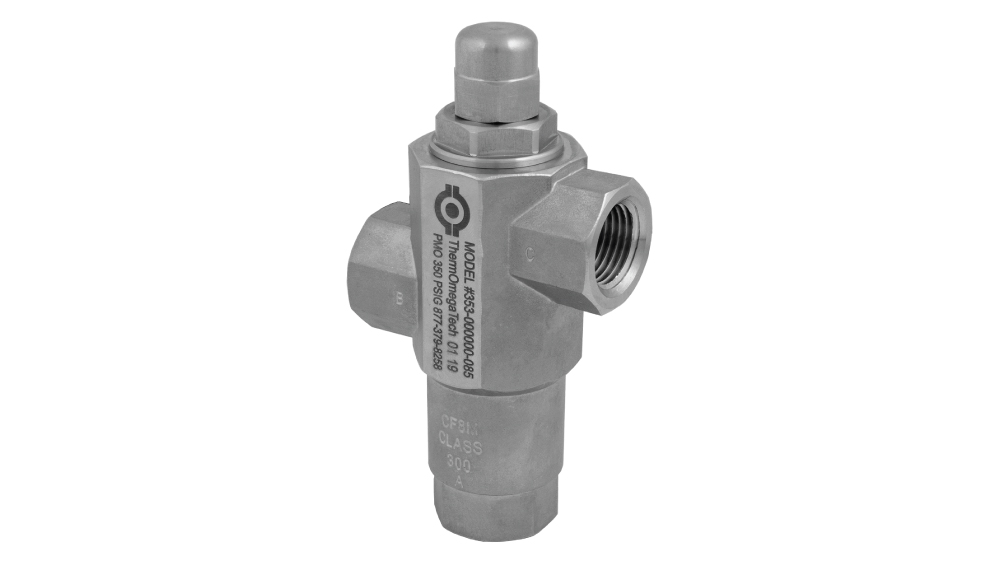
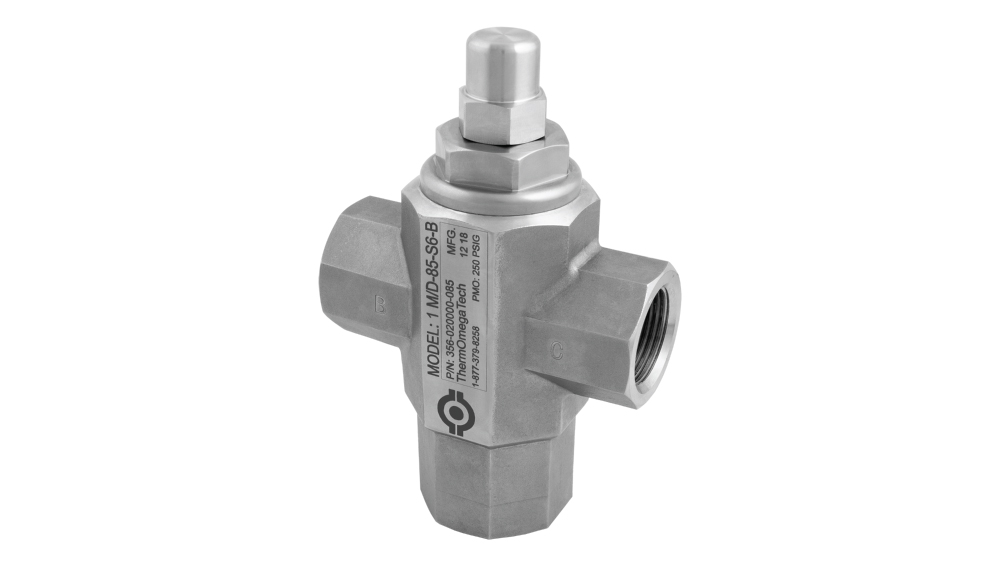
- Sizes: ½”, 1”, 2” NPT
- Maximum Operating Pressure for ½”: 350 PSIG (24 bar)
- Maximum Operating Pressure for 1” & 2”: 250 PSIG (17.2 bar)
- Maximum Operating Temperature: 250°F (121°C)
- Set Point Temperature Range: 35°F to 210°F (1.7°C to 98.9°C)
- Standard Materials: 303 Stainless Steel, 316 Stainless Steel, and Bronze
- Standard Seal Materials: Buna-N, EPDM, Viton, or Fluorsilicone
Ordering
| Part Number | Description |
| 353-00X000-XXX | 1/2” M/D Valve – 316 SS Body, 300 Series SS Internals |
| 353-02X000-XXX | 1/2” M/D Valve – all 316 SS construction |
| 353-01X000-XXX | 1/2” M/D Valve – Bronze |
| 356-00X000-XXX | 1” M/D Valve – Bronze |
| 356-01X000-XXX | 1” M/D Valve – 303 SS |
| 356-02X000-XXX | 1” M/D Valve – 316 SS Special Order Only |
| 359-0X4000-XXX | 2” M/D Valve – SS |
Ordering & Configuration Notes
- Seal material compatibility “X” available (replace singular X of part number with corresponding number below):
- 0 – Buna-N for air (to 250°F), water, fuel, oil, gas, and petroleum-based hydraulic oils
- 1 – Viton for air (to 450°F), fuel, oil, gas, and petroleum-based hydraulic oils
- 2 – EPDM for air (to 300°F), water, ketones, and synthetic hydraulic oils
- 3 – Fluorosilicone for air (to 400°F), aerospace industry petroleum oils/fuels, and diester-based lubricants
- For most applications: pressure difference between hot and cold ports should not exceed 10 PSI.
- Set point temperatures “XXX” available: 035°F, 045°F, 050°F, 060°F, 070°F (+/- 8°F), 085°F, 090°F, 100°F, 105°F, 110°F, 125°F, 130°F (+/- 8°F), 135°F, 147°F (+/- 8°F), 152°F (+/- 8°F), 160°F, 170°F, 190°F, 200°F, 205°F, 210°F.
- Unless otherwise noted, during operation the valve will modulate the Cold side (C port) closed at 5°F below the set point, and the Hot side (B port) closed at 5°F above the set point.
- Customized temperature, materials, and port positions available upon request.
- M/D valves are not suitable for mixing steam and water.
How Thermostatic Mixing Valves & Diverting Valves Work
In mixing applications, the M/D functions as a temperature mixing valve, with ports B and C serving as the hot and cold inlets. The valve modulates flow from each inlet to maintain the specified temperature at outlet port A.
In diverting applications, port A serves as the inlet. The valve responds to fluid temperature and proportions flow between outlet ports B and C. In thermal bypass systems, this allows flow to be directed through a heat exchanger or cooler or through the bypass circuit as thermal conditions change. This action assures rapid system warm-up, accurate control of fluid temperature, and reduced back pressure in the return.